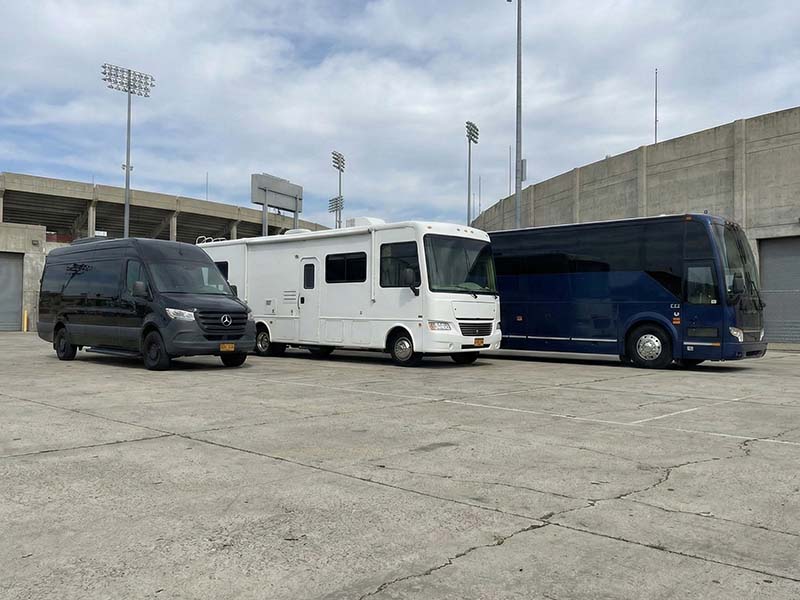
One of the first big transportation decisions a band makes is whether to tour in a van, an RV, or a full tour bus. Each option has its place, and none of them are inherently "wrong." But they solve very different problems, and choosing the wrong one can quietly drain a tour budget or create operational headaches that compound over time.
This guide breaks down the real-world pros and cons of each option based on how tours actually run, not how they look on Instagram.
The short answer
For most band tours the van wins: lowest cost, simplest logistics, and the most flexibility when plans change. On the 30-day, 10,000-mile example tour in this guide, the estimated all-in cost is about $14,639 in a van, $19,525 in an RV, and $81,767 in a tour bus (roughly $98, $130, and $545 per musician per day). A bus starts to make sense once consistent ticket revenue can absorb its fixed costs, and an RV fits slower-paced tours with flexible routing.
The all-in cost: van vs. RV vs. tour bus
Numbers tell the story faster than adjectives. The table below estimates the all-in transportation cost of a 30-day national tour covering 10,000 miles for a 5-person band, including rental, fuel at current national average prices, driver wages and lodging where applicable, band hotel rooms, and the per-mile, deadhead, generator, waste-tank, and cleaning fees that tour-bus companies typically charge on top of the day rate.
| Line item | Van | RV | Tour Bus |
|---|---|---|---|
| Daily rental rate | $200 | $300 | $1,200 |
| Rental (30 days) | $6,000 | $9,000 | $36,000 |
| Mileage fees | — | $3,500 $0.35/mi × 10,000 |
$15,000 $1.50/mi × 10,000 |
| Deadhead fee | — | — | $2,500 bus to/from home base |
| Fuel (10,000 mi) | $2,139 18 mpg diesel |
$4,125 8 mpg gas |
$6,417 6 mpg diesel |
| Driver wages | — band drives |
— band drives |
$12,000 $400/day × 30 |
| Driver per diem & tip | — | — | $1,800 $60/day × 30 |
| Driver hotel (day room) | — | — | $3,000 25 nights × $120 |
| Band hotels | $6,500 25 nights × 2 rooms × $130 |
$1,950 15 nights × 1 room × $130 |
$1,300 10 nights × 1 room × $130 |
| RV park / bus parking / permits | — | $750 15 nights × $50 |
$500 |
| Generator | — | $200 propane / fuel |
$2,250 $75/day × 30 |
| Waste tank / toilet fee | — | — | $500 |
| End-of-tour cleaning | — | — | $500 |
| Estimated all-in total | $14,639 | $19,525 | $81,767 |
| Per musician, per day | ~$98 | ~$130 | ~$545 |
Estimates use national-average fuel prices (regular gas ~$3.30/gal, diesel ~$3.85/gal) and typical 2026 rental rates. Tour-bus fees follow common entertainer-coach billing practice and vary widely by operator and contract. Hotel nights assume the band sleeps in the vehicle when it's bunked (RV, bus) and books rooms on off-days and shower days. Actual costs vary by city, season, vehicle class, and routing. Band per diems, crew vehicles, and backline trailers are not included.
The touring van: the default for a reason
For most developing and mid-level touring bands, a passenger van (often a Sprinter-style layout) is the most common choice, not because it's glamorous, but because it balances cost, flexibility, and logistics better than the alternatives.
Why vans work
- Lower total cost: rentals, fuel, insurance, and parking are all substantially cheaper than RVs or buses.
- Simpler logistics: easier to park, fuel, service, and route through cities.
- Driver flexibility: no CDL required in most cases.
- Right-sized: enough space for people and gear without paying for unused capacity.
- Adaptable: easier to swap vehicles or change configurations between tour legs.
Where vans fall short
- No built-in sleeping, so hotels or overnight drives are part of the plan.
- Less personal space on very long runs.
- Can feel tight with large crews or heavy backline.
Vans tend to win when the priority is staying mobile, keeping costs variable, and avoiding operational complexity. Our vehicle comparison guide breaks down the differences between Sprinters, Transits, and Express vans if you're weighing your options.
The RV: appealing on paper, complicated in practice
RVs attract bands because they promise sleeping, a kitchen, and "one vehicle does everything." For certain niche tours, they can work, but they also introduce tradeoffs many first-time tours underestimate.
Why RVs seem attractive
- Sleeping space reduces hotel nights.
- Kitchen can lower food costs if used consistently.
- Feels like a self-contained touring solution.
Where RVs get expensive or difficult
- Fuel costs: RVs typically get significantly worse MPG than vans.
- Maintenance risk: RV systems (plumbing, generators, appliances) add failure points.
- Parking limitations: many venues and cities restrict RV parking.
- Service delays: RV repairs can be slower and harder to source mid-tour.
- False savings: hotel savings are often offset by fuel, maintenance, and downtime.
RVs tend to work best for slower-paced tours with fewer shows per week and flexible routing, not tight, city-heavy schedules.
The tour bus: comfortable, efficient, and a big commitment
A tour bus is the gold standard for comfort and overnight efficiency. For the right tour, it can be the most effective option. But it also comes with the highest financial and operational bar.
Why buses shine
- Overnight travel: drive while sleeping, maximizing show-to-show efficiency.
- Comfort: bunks, lounge space, bathroom, and climate control.
- Professional driver: reduces fatigue and safety concerns for the band.
The realities that limit buses
- Cost: daily bus rates, fuel, driver pay, and tips add up quickly.
- Minimum scale: hard to justify without consistent ticket revenue.
- Routing constraints: not every venue or city is bus-friendly.
- All-or-nothing: fewer flexible downsizing options if budgets tighten mid-tour.
Tour buses tend to make sense when a band is touring consistently at a level where efficiency and rest directly protect revenue, and where the budget can absorb the fixed costs.
A side-by-side reality check
- Lowest upfront cost: Van
- Lowest ongoing complexity: Van
- Most flexible: Van
- Most comfortable: Tour bus
- Most self-contained: RV (with tradeoffs)
- Highest financial commitment: Tour bus
Why vans end up being the default
Vans aren't perfect, but they fail gracefully. When budgets tighten, routing changes, or something unexpected happens, vans usually offer the most options and the fewest irreversible decisions.
That's why many experienced tour managers start bands in vans, move to buses only when the economics clearly support it, and approach RVs cautiously unless the tour structure truly fits.
The right question to ask
Instead of asking "What's the coolest option?" most experienced teams ask:
Which choice gives us the most flexibility if things don't go perfectly?
Touring rarely goes exactly as planned. Transportation that absorbs change instead of amplifying it usually wins over the long run.
This guide is intended for general informational purposes only and reflects common touring practices. It is not financial, legal, or safety advice. Touring needs vary, and bands should evaluate transportation choices based on their own schedules, budgets, and risk tolerance.
Frequently asked questions
How much does it cost to tour in a van vs. an RV vs. a tour bus?
For a 30-day national tour covering 10,000 miles with a 5-person band, this guide estimates about
$14,639 all-in for a van, $19,525 for an RV, and $81,767 for a tour bus, including rental, fuel,
hotels, and the fees each option carries. Per musician that works out to roughly $98, $130, and
$545 per day.
Why is a tour bus so much more expensive than a van?
The day rate (about $1,200 in the example) is only the start. Bus companies typically add per-mile
fees, a deadhead fee to and from home base, driver wages, driver per diem and tips, driver day
rooms, and generator, waste-tank, and cleaning fees on top, plus fuel at around 6 mpg. In the
example those extras take the bus from $36,000 in rental to $81,767 all-in.
Is an RV a good idea for a band tour?
It can work for slower-paced tours with fewer shows per week and flexible routing, but RVs
typically get significantly worse fuel economy than vans, their systems (plumbing, generators,
appliances) add failure points, and many venues and cities restrict RV parking. The hotel savings
are often offset by fuel, maintenance, and downtime.
When should a band move from a van to a tour bus?
When the band is touring consistently at a level where overnight travel, rest, and a professional
driver directly protect revenue, and the budget can absorb the fixed costs. Many experienced tour
managers start bands in vans and move to buses only when the economics clearly support it.